
Why Don't I Feel Good Enough? Understanding Self-Worth
If you've asked yourself this question before, you're in good company.
Not everything in your life has to be going wrong for you to feel this way. You might be successful at work and still feel like you don't measure up. You might have many friends and still feel inadequate, disconnected, or lonely in a crowd. You might receive praise for your appearance, accomplishments, or resilience and still experience imposter syndrome, wondering if people really know you at all.
So what's the deal?
With all that is going right, why do I still feel this way?
Why don't I feel worthy, even when people tell me I am?
When Being Loved Isn't Enough
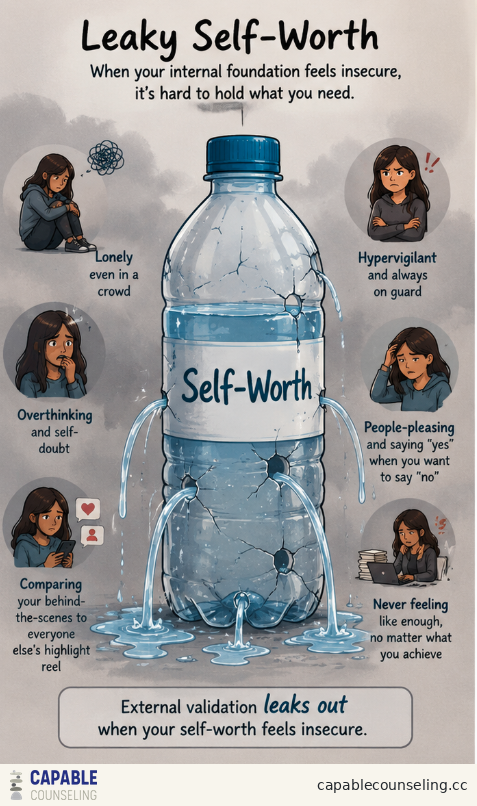
I like to think about self-worth a little like a plastic water bottle.
A bottle has the capacity to hold water, but its structure needs to be secure enough to contain it. If there are holes in the bottom, the bottle may collect water for a while, but eventually it will begin to leak.
Our sense of self-worth can work in a similar way.
The structure of the bottle represents the internal worth we hold for ourselves. Do I believe I am worthy? Do I treat myself with the same value and care that I want others to give me? Can I receive encouragement, correction, praise, or love without immediately questioning whether I deserve it?
The water represents the validation and feedback we receive from the outside world. A compliment, promotion, accomplishment, or expression of love can feel really good—and it should! But if our internal sense of worth is fragile, that external validation may not stay with us for very long.
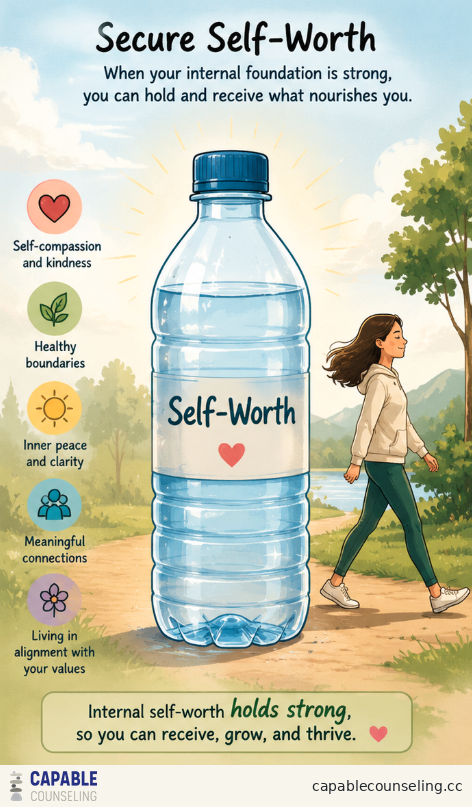
Before we can fully receive what we give ourselves (self-compassion, encouragement, praise, or even healthy redirection) or what others give us, we need a strong enough internal foundation to hold it.
You Can Be Surrounded and Still Feel Alone
Low self-worth can sometimes show up as loneliness, shallow or unsatisfying connections, or difficulty feeling truly known in relationships.
And social media doesn't make this comparison any easier.
We see carefully selected depictions of other people's lives and compare them to everything we know about our own. One snapshot can make it appear as though someone else has everything together while we are left staring at everything that feels wrong with our own lives.
But we rarely see the whole story.
You can be in a room full of people and still feel alone.
You can have a loving partner and still feel disconnected.
You can have hundreds of people following you and still wonder whether anyone really knows you.
When we repeatedly experience disconnection, rejection, or loneliness, it can reinforce painful beliefs such as I'm not wanted, I'm not enough, or something must be wrong with me. Those beliefs can then shape the way we see ourselves and the way we approach relationships.
When Your Worth Becomes Conditional
Sometimes, we try to compensate for low self-worth through hypervigilance around achievement, appearance, relationships, productivity, or people-pleasing.
Returning to our water-bottle metaphor, instead of repairing the bottle, we actively trying to refill it.
We work harder.
We say yes when we want to say no.
We sacrifice our needs to keep other people happy.
We change our appearance.
We seek another accomplishment.
We compromise our values.
We become overly focused on how other people perceive us.
The problem isn't achievement, caring for others, working hard, or wanting to look our best. These can all be healthy parts of life. The problem develops when we begin using them as evidence that we are worthy.
When our worth becomes dependent on what we accomplish, how we look, whether someone chooses us, or whether everyone around us is happy, we can become exhausted trying to prove something that never needed to be proven in the first place.
Learning to Treat Yourself Differently
One way to begin strengthening self-worth is through self-compassion.
Research consistently links self-compassion with greater psychological well-being, resilience, and healthier ways of responding to difficult emotions. Self-compassion doesn't mean making excuses for yourself, enabling yourself, or avoiding accountability. It means learning to respond to yourself with understanding rather than shame when you struggle, make a mistake, or fall short of your expectations.
Try asking yourself:
Would I talk to someone I love this way?
If not, what would I say to them instead?
Self-compassion can give you permission to try something new, learn about yourself, clarify your values, make mistakes, and keep growing without turning every mistake into evidence that you're not enough.
Sometimes we speak to ourselves in the same harsh ways we were spoken to or treated in the past. Healing can involve learning a different way.
You might even ask:
If I could go back and talk to my younger self during the moments when I felt most inadequate, how would I have wanted someone to respond to me?
Then begin practicing that response with yourself today.
Little by little, you can begin repairing and strengthening the bottle.
Your Worth Isn't Something You Have to Earn
Perhaps the most important message I want you to hear is this:
You do not have to earn or prove your worth.
Learning, changing, making mistakes, and growing are all part of being human. You are allowed to be a work in progress while still recognizing your value.
Self-worth isn't about becoming perfect. It's about developing a relationship with yourself that allows you to grow without constantly questioning whether you deserve love, belonging, or compassion.
And you don't have to figure this out alone.
Therapy can provide a place to explore where your beliefs about yourself came from, identify the values that matter to you, and develop tangible ways to practice self-compassion, boundaries, and healthy self-worth.
If any of this resonates with you, scroll down to schedule a free consultation and let's explore what building a stronger sense of self might look like for you.
Request a Confidential Consultation
Phone consultations are complimentary and will be returned within 24 hours of submission. To help me best meet your needs, please include your reason for seeking counseling, any questions you may have, and your preferred time for a consultation call.
Your privacy matters. From the moment you reach out, your information is kept confidential and secure. We do not share your information with third parties, except when required by law.
Consultation requests submitted after 5:00 PM on Saturday will be returned on Monday.