
Why Does Anxiety Make Me Fear What Hasn't Happened Yet?
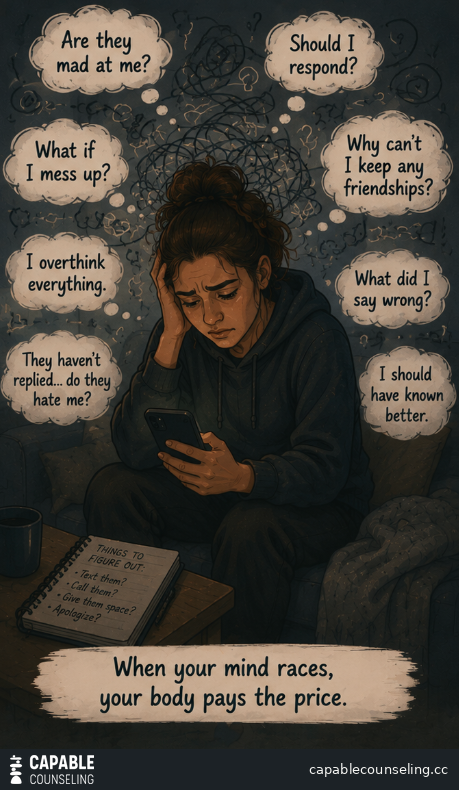
Have you ever noticed yourself worrying about something that hasn't happened yet?
What if something goes wrong?
What if they're upset with me?
What if I can't handle it?
What if I make the wrong decision?
What if everything falls apart?
If you've found yourself asking these questions, you're not alone.
Anxiety often begins with something that feels quite reasonable—and even productive: trying to prepare for the future or solve a problem before it happens. The problem is that sometimes our brains don't know when to stop preparing.
When Your Brain Tries to Write the Future
Anxiety is often connected to the anticipation of uncertain or potentially threatening events. Your brain is constantly using information from the past and present to predict what might happen next. This is an incredibly useful ability—until the prediction itself becomes the source of distress.
Think about it this way: your mind is trying to write the story of what might happen next. But your body can begin experiencing the emotional and physical response to that story right now.
You haven't lost the job, but your heart is racing.
You haven't had the conversation, but your stomach is in knots.
You don't know what the doctor will say, but you already feel terrified.
The event is in the future, but your nervous system is responding in the present.
Research on the neuroscience of anxiety shows that anticipating uncertain threats involves a network of brain regions involved in threat detection, attention, emotion, and decision-making. In other words, your brain is doing what it was designed to do: trying to anticipate danger and prepare you for it.
When Anxiety Becomes Dysregulation
The difficulty begins when your body stays in a state of heightened arousal even though there is no immediate danger that requires action.
You may notice:
racing or ruminating thoughts
rapid heartbeat
muscle tension
shallow breathing
stomach discomfort
difficulty concentrating
irritability
restlessness
emotional reactivity
feeling like you need to do something right now
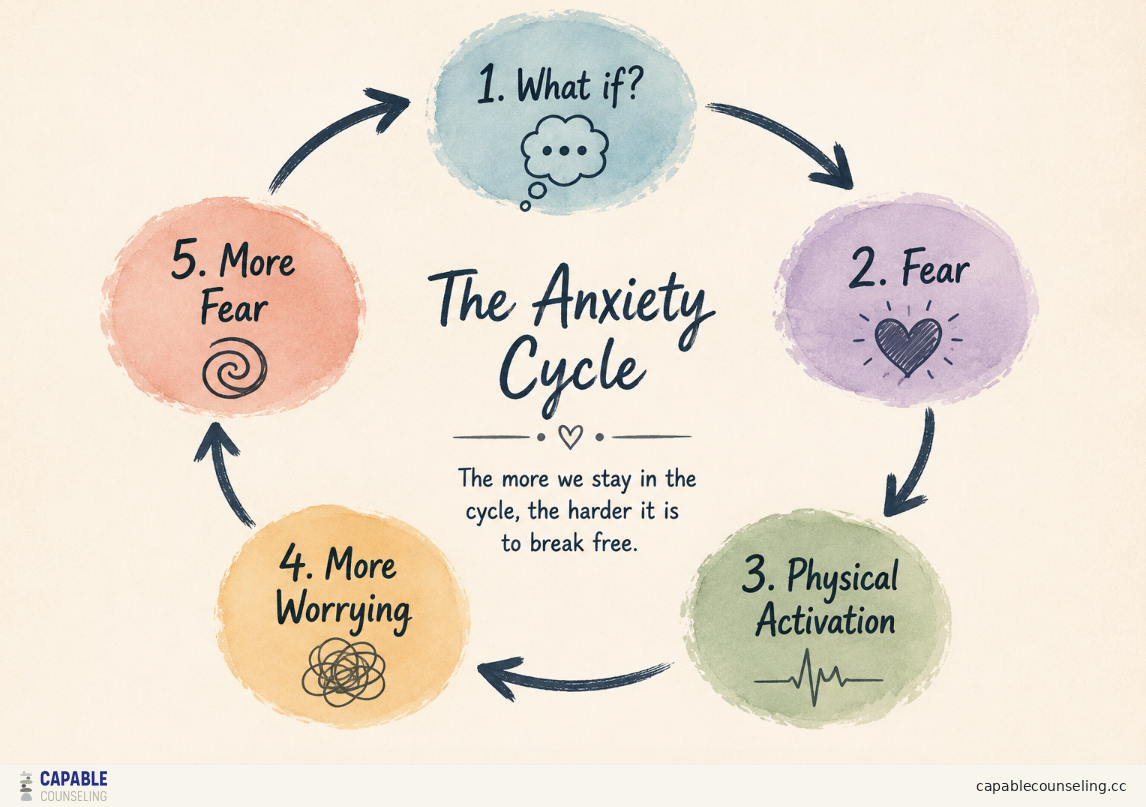
When your nervous system is activated, it can become harder to think through a situation with flexibility. Instead, your attention may become increasingly focused on finding an answer, preventing a bad outcome, or gaining certainty. And this is where anxiety can become a cycle:
The goal isn't to eliminate every anxious thought. The goal is to learn how to recognize the mental, emotional, and physical signs that your body is becoming activated by a possibility—and learn how to respond rather than automatically react.

Before You Solve the Problem, Regulate the Body
When anxiety takes over, you may feel an urgent need to figure everything out immediately.
But sometimes the first step isn't thinking harder; it's regulating your body.
Try grounding yourself in what is happening right now. Take a slow, comfortable breath. Feel your feet on the floor. Notice five things you can see. Stretch. Walk. Look around your environment and name where you are.
You can also use mindfulness to notice the thought without immediately following it:
I'm having the thought that something might go wrong.
That small shift can create space between you and the thought.
Then ask yourself:
Is this thought simply a thought, or is it an instruction that actually requires action?
Not every thought requires an answer.
Not every "what if" requires a solution.
Sometimes the most helpful response is:
I don't know what will happen yet.
Maybe this will happen…but maybe it won’t.
I can handle what is actually happening right now.
I don't need to solve tomorrow today.
Mindfulness-based approaches have been shown to reduce anxiety symptoms. The goal isn't to force yourself to stop thinking, but to develop a different relationship with your thoughts and return your attention to the present.
Controlled breathing can also be a useful regulation tool. Research suggests that breathing exercises can help reduce anxiety and stress, although more research is still needed to understand which approaches work best for whom.
You Are Not Your Anxiety
Anxiety often tells us that if we think about something enough, we can prevent it from happening.
But worrying isn't the same thing as preparing.
Sometimes preparation is useful: make the appointment, have the conversation, make the plan, gather the information.
And sometimes there is nothing to do yet.
When there is nothing to do, your work may simply be to come back to the present.
You don't have to know how the entire story ends to take care of yourself in this moment.
You don't have to solve the future to feel safe in the present.
If anxiety has become a constant part of your life, therapy can help you understand the patterns behind your worry, recognize what triggers your nervous system, and develop practical tools for regulation and responding differently to anxious thoughts.
You don't have to do this work alone. If you're ready to work on anxiety, I'd be glad to walk alongside you. Scroll down to schedule a free consultation.
Request a Confidential Consultation
Phone consultations are complimentary and will be returned within 24 hours of submission. To help me best meet your needs, please include your reason for seeking counseling, any questions you may have, and your preferred time for a consultation call.
Your privacy matters. From the moment you reach out, your information is kept confidential and secure. We do not share your information with third parties, except when required by law.
Consultation requests submitted after 5:00 PM on Saturday will be returned on Monday.