
Why Can't We Communicate?!
Have you ever walked away from a conversation with your partner wondering, How did we even get here?
You were trying to explain how you felt.
They became defensive.
You tried to clarify.
They heard criticism.
Suddenly, you're arguing about something completely different from where the conversation started.
Communication problems are one of the most common struggles couples experience. But sometimes the problem isn't that we don't know how to communicate.
The problem is that two people can experience the exact same conversation very differently.
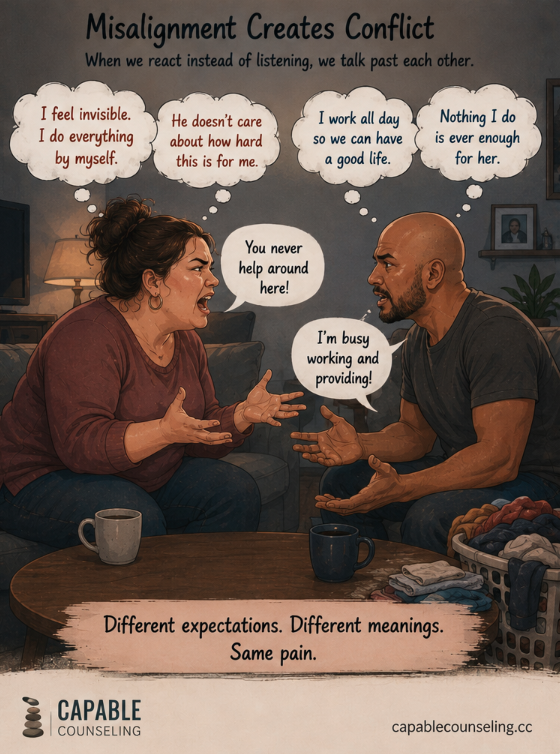
Two People, Two Histories
Before you became a couple, you were two separate people living two separate lives.
You grew up in different families. You learned different ways of handling emotions, conflict, affection, responsibility, money, intimacy, and stress. You developed your own expectations about what love and partnership should look like.
Then you chose each other and began trying to build one life together.
Sometimes we enter relationships with expectations we don't even realize we have:
If you love me, you'll know what I need.
If I'm important to you, you'll make time for me.
If you're upset, we should talk about it.
If you're upset, you should give me space.
Neither person necessarily enters the relationship intending to hurt the other. You may simply be operating from two different maps of what a relationship is supposed to look like.
The Gottman Method recognizes that underneath many relationship conflicts are deeper values, beliefs, needs, and meanings. This is one reason simply solving the surface-level disagreement doesn't always solve the problem.
Sometimes the argument isn't really about the dishes.
It's about what the dishes have come to mean.
It's Not Always What Was Said—It's What Was Heard
Our partner often becomes one of the most trusted and emotionally significant people in our lives. Because of that, their words can carry tremendous weight. Imagine one partner says: "You never help me around here."
They may be trying to communicate: I'm overwhelmed. I need you.
But their partner may hear: You're failing me.
Or one partner says: "I need some space."
They may mean: I'm overwhelmed and need a little time to calm down.
But their partner hears: I don't want you. I'm leaving.
Now the conversation isn't only about what was said. It's about the meaning and emotion attached to what was heard.
This is where old experiences can sometimes enter a present-day relationship. If you've spent parts of your life feeling unheard, rejected, criticized, controlled, abandoned, or as though your needs didn't matter, certain interactions with your partner may touch those vulnerable places.
That doesn't mean every reaction comes from childhood or that your partner's behavior doesn't matter. It means we all bring a history into the room with us.
Do You Want to Be Right—or Do You Want to Understand?
When we feel misunderstood, our instinct is often to explain ourselves.
That's not what I said.
That's not what I meant.
You're taking it the wrong way.
You're not listening to me.
And sometimes you may be factually correct.
But there is another question worth asking: What is my partner experiencing right now?
Dr. John Gottman's work with couples emphasizes the importance of understanding your partner's subjective experience rather than immediately trying to persuade them to accept yours.
Listening doesn't require your agreement.
It doesn't require your cosign.
It doesn't even require you to completely understand why they feel the way they do.
It requires curiosity about their lived experience.
What did you hear when I said that?
What did that feel like for you?
What did my facial expression or tone communicate?
What did you need from me in that moment?
And then perhaps the most important question: Was the impact of what I communicated consistent with my intent?
If my intent was to tell my partner that I needed them, but what they experienced was criticism and rejection, continuing to prove what I meant may not move us toward connection.
Understanding their experience might.
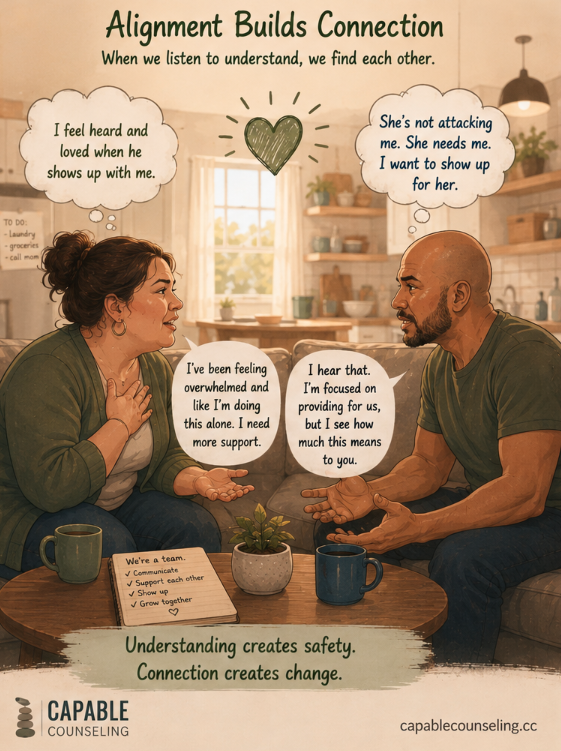
Speak to Be Heard. Listen to Understand.
Communication is a two-person process.
As the speaker, ask yourself: How can I communicate my pain without attacking the person I want to hear it?
Instead of: "You don't care about me. You're always on your phone."
Try: "I've been feeling disconnected from you lately. I miss you, and I'd really like some time together tonight."
This reflects what Gottman calls a softened start-up: beginning difficult conversations by describing your experience and expressing what you need rather than beginning with blame or criticism.
And when you're the listener, the work changes: Can I hear my partner's pain without immediately defending myself against it?
That can be incredibly difficult, especially when what they're saying touches your own feelings of inadequacy, rejection, lack of control, or fear of not being loved.
Sometimes the need to prove that we're right isn't really about winning an argument. It may be protecting something much more vulnerable underneath.
From Reaction to Attunement
The goal of healthy communication isn't to agree on everything. It’s even to avoid conflict! And it certainly isn't to never hurt each other's feelings.
You're two different people. There will be misunderstandings, disagreements, missed signals, bad days, and moments when one of you simply gets it wrong.
The work is learning what happens next.
Can I slow down my reaction long enough to become curious about you?
Can I recognize when my own pain is influencing what I'm hearing?
Can I communicate what I need without attacking you?
Can I listen to your experience without requiring it to match mine?
Can we repair when we get it wrong?
This is where communication becomes something deeper than choosing the "right words."
It becomes attunement—learning to recognize and respond to your partner's emotional experience while still remaining connected to your own.
The question becomes less: Who is right?
And more: What is happening between us, and how can we respond in a way that protects the relationship we're trying to build?
You Don't Have to Keep Having the Same Conversation
If you and your partner continue having the same argument with different details, the problem may not be that you haven't explained yourselves well enough.
There may be something underneath the conversation that neither of you has been able to reach.
Couples therapy can provide a space to slow these interactions down, understand the deeper emotions and experiences influencing your reactions, and practice communicating in ways that create greater understanding, safety, and connection.
The goal isn't to become two people who always agree. It's to become two people who know how to find each other when you don't.
If you and your partner are ready to communicate differently, I'd be glad to help you begin. Scroll down to schedule a free consultation.
Request a Confidential Consultation
Phone consultations are complimentary and will be returned within 24 hours of submission. To help me best meet your needs, please include your reason for seeking counseling, any questions you may have, and your preferred time for a consultation call.
Your privacy matters. From the moment you reach out, your information is kept confidential and secure. We do not share your information with third parties, except when required by law.
Consultation requests submitted after 5:00 PM on Saturday will be returned on Monday.